
Bioinformatics Analysis Services
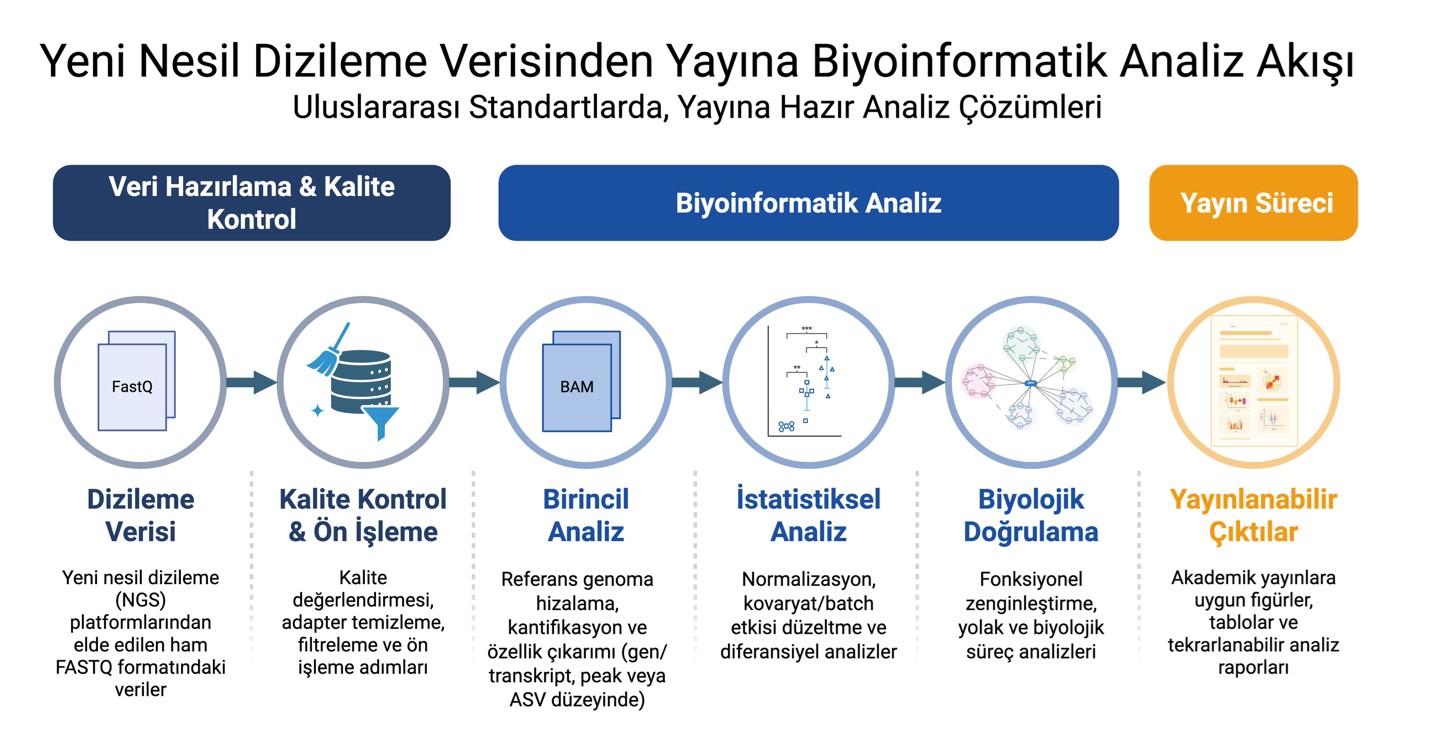
Bioinformatics Analysis Unit is a service-oriented platform dedicated to transforming large-scale next-generation sequencing (NGS) data into biologically meaningful, statistically robust, and publication-ready results. We provide transparent, reproducible, and internationally standardized bioinformatics analysis solutions for academic research groups and R&D teams across a broad range of applications, including RNA sequencing, single-cell analyses, epigenomics, metagenomics, and whole-genome sequencing (WGS).
The unit delivers end-to-end bioinformatics analysis services for genomic, transcriptomic, and proteomic data. All stages of analysis—ranging from data quality control and pre-processing to advanced statistical modeling, biological interpretation, and publication support—are conducted with a strong emphasis on scientific rigor and methodological consistency. Analysis strategies are tailored to the specific needs of each project, with the goal of accelerating research workflows and generating highly reliable, reproducible results.
Services
-
RNA-seq / miRNA / tRNA Analyses
Comprehensive analysis of RNA sequencing data, from quality control to differential expression analysis and functional interpretation. -
16S / 18S rRNA Microbiome Analyses
Taxonomic profiling, diversity structure assessment, and comparative analysis of microbial communities. -
ATAC-seq Analyses
Genome-wide identification of chromatin accessibility and analysis of differentially accessible regions. -
ChIP-seq Analyses
Analysis of genome-wide binding profiles of transcription factors and histone modifications. -
Single-Cell RNA-seq Analyses
Gene expression profiling at the single-cell level, cell type identification, and analysis of cellular heterogeneity. -
Whole Genome Sequencing (WGS) Analyses
Variant calling, annotation, and quality control analyses of whole-genome sequencing data. -
Publication Support Services
Preparation of figures, tables, methods sections, and supplementary materials for academic publications. -
Pipeline Development (Nextflow)
Development of reproducible, scalable, and fully documented bioinformatics analysis pipelines. -
Consulting & Experimental Design
One-to-one scientific consulting for experimental planning, analysis strategy development, and data interpretation.
Unit Coordinator: Leman BİNOKAY
High-Performance Computing (HPC) Service
In addition to its core functions, the Bioinformatics Unit provides high-performance computing (HPC) services. Equipped with high-performance computing systems, large-scale storage solutions, and various software licenses, our infrastructure enables researchers to conduct their projects efficiently and effectively.
Our unit aims to support excellence in research and innovation by providing the best computational resources and technologies; thus, we strive to remove computational barriers to scientific discovery and empower our researchers to solve increasingly complex scientific problems.
What We Offer as Part of Our Services
Hardware and Software Provision: We prepare the ideal environment for your scientific calculations by offering the most up-to-date and suitable computing resources.
User Training and Support: We organize training sessions ranging from basic HPC concepts to advanced programming techniques, ensuring our users utilize these resources with maximum efficiency.
Researching New Technologies: We continuously enhance our research capabilities by following global developments in fields such as Artificial Intelligence (AI), Deep Learning, and high-performance networking.
Collaboration and Partnerships: Through national and international collaborations, we increase knowledge sharing and the effective use of resources.
Click here to view detailed information about our services.
Click here to view frequently asked questions (FAQ).
Click here to view the current price list.
Contact: Hüseyin GÜNER - huseyin.guner@ibg.edu.tr
Publications Contributed By Our Unit
Öztemur Islakoğlu, Y., Korhan, P., Binokay, L., Keleş, B., Bağırsakçı, E., Uludağ Taşçıoğlu, M., Şamdancı, E., Karakülah, G., & Atabey, N. (2025). Fusion transcripts landscape in hepatocellular carcinoma and potential impact on the expression of fusion partners. RNA Biology, 22(1), 1–16. https://doi.org/10.1080/15476286.2025.2529036
Karacicek, B., Katkat, E., Binokay, L., Ozhan, G., Karakülah, G., & Genc, S. (2025). The role of tRNA fragments on neurogenesis alteration by H₂O₂-induced oxidative stress. Journal of Molecular Neuroscience, 75(2), 1–12. https://doi.org/10.1007/s12031-025-02330-x
Arioz, B. I., Binokay, L., Tastan, B., Genc, B., Cotuk, A., Dursun, E., Gezen-Ak, D., Hanagası, H., Gurvit, İ. H., Bilgic, B., Bagriyanik, A., Karakülah, G., Yener, G. G., & Genc, S. (2025). Characterization of tRNA-derived fragments in the small neuron-derived extracellular vesicles of Alzheimer’s disease patients. Brain Research, 1862, 149730. https://doi.org/10.1016/j.brainres.2025.149730
Günay, Ç., Binokay, L., Karakülah, G., Polat, İ., Yiş, U., & Hiz-Kurul, S. (2025). Exploring molecular pathways underlying epilepsy development in intellectual disability. Neuropediatrics.
Karabicici, M., Akbari, S., Caliskan, C., Celiker, C., Oz, O., Binokay, L., Karakülah, G., Senturk, S., & Erdal, E. (2025). Modeling hepatic fibrosis in TP53 knockout iPSC-derived human liver organoids. Molecular Oncology. https://doi.org/10.1002/1878-0261.70119
Koçak, G., Uyulgan, S., Polatlı, E., Sarı, V., Kahveci, B., Bursalı, A., Binokay, L., Reçber, T., Nemutlu, E., Mardinoğlu, A., Karakülah, G., Utine, C. A., & Güven, S. (2024). Generation of anterior segment of the eye cells from hiPSCs in microfluidic platforms. Advanced Biology, 8(5), 2400018. https://doi.org/10.1002/adbi.202400018
Binokay, L., Oktay, Y., & Karakülah, G. (2024). An API for dynamic estimation of reference intervals for functional abundances of gut microbiota. Biologia, 79(1), 343–353. https://doi.org/10.1007/s11756-023-01556-7
Kahveci, B., Polatlı, E., Evranos, A. E., Güner, H., Baştanlar, Y., Karakülah, G., & Güven, S. (2025). BrAIn: A comprehensive artificial intelligence-based morphology analysis system for brain organoids and neuroscience. bioRxiv. https://doi.org/10.1101/2025.02.19.638973
Vasilopoulos, S. N., Güner, H., Uça Apaydın, M., Pavlopoulou, A., & Georgakilas, A. G. (2023). Dual targeting of DNA damage response proteins implicated in cancer radioresistance. Genes, 14(12), 2227. https://doi.org/10.3390/genes14122227https://doi.org/10.3390/genes14122227
Gunalp, S., Goksu Helvaci, D., Oner, A., Bursalı, A., Conforte, A., Güner, H., Karakülah, G., Szegezdi, E., & Sag, D. (2023). TRAIL promotes the polarization of human macrophages toward a proinflammatory M1 phenotype and is associated with increased survival in cancer patients with high tumor macrophage content. Frontiers in Immunology, 14, 1209249. https://doi.org/10.3389/fimmu.2023.1209249