
Zebrafish Models Laboratory
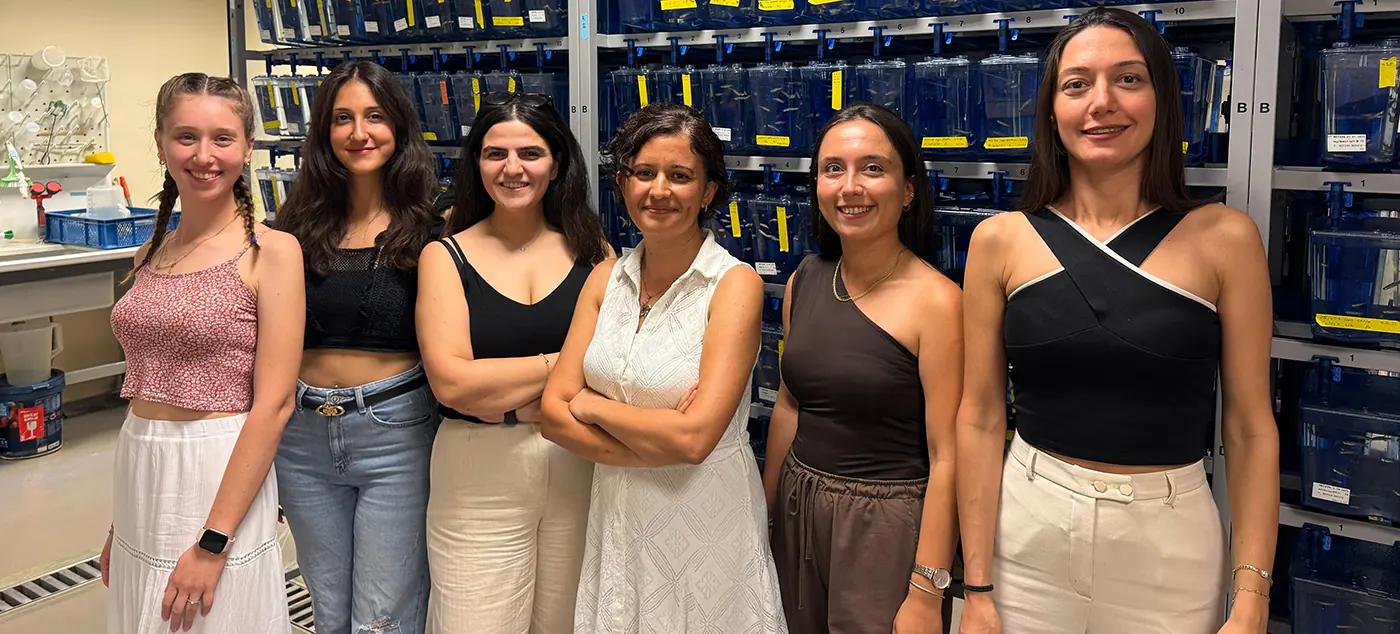
Principal Investigator: Asst. Prof. Gülçin ÇAKAN AKDOĞAN
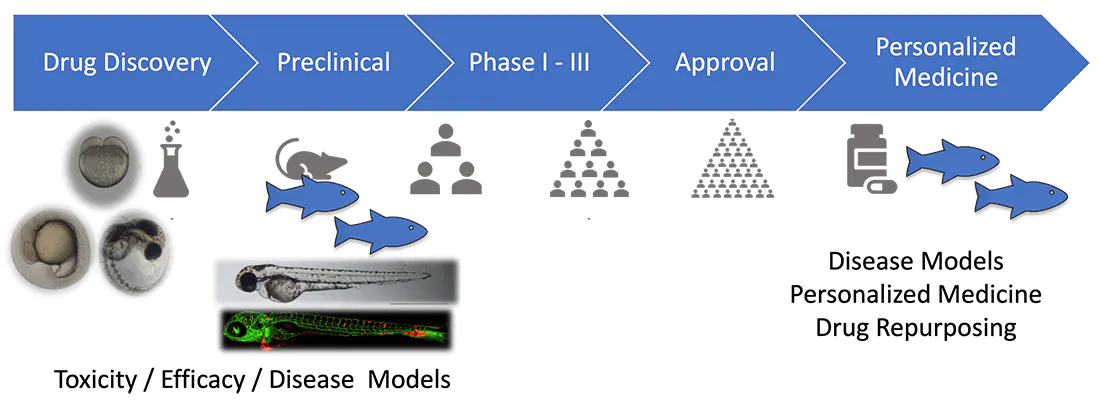
Zebrafish Modelling Research Group develops preclinical models and drug screening platforms for rare and common diseases using the zebrafish (Danio rerio) model organism. By utilizing both zebrafish and human cell-based models, we perform efficacy and toxicity analyses of biopharmaceutical products ¹.
One of our main research area is development of rare disease model development with a focus on therapy development. We are currently working on gene therapy strategies for corneal dystrophies, using a preclinical zebrafish model we have developed². This model serves as a valuable tool for elucidating the molecular mechanisms underlying rare eye diseases and for advancing targeted therapeutic development. In addition, we are developing zebrafish models for liver diseases such as non-alcoholic fatty liver disease (NAFLD), hyperbilirubinemia, and drug-induced liver injury. Through these models, we aim to uncover the biological basis of these conditions and identify potential therapeutic targets. We develop models and conduct mechanistic studies examining the interactions of nutrients, activity, and genetic differences in the liver-gut-brain axis.
Our research integrates fundamental biological discovery with biopharmaceutical development processes, with the overarching goal of delivering innovative and effective solutions in translational medicine.
Our Service and Research Areas
1. Rare disease preclinical models
Creating CRISPR-CAs9-mediated mutations to modify target genes, completing phenotypic characterizations of the resulting mutants, and conducting drug testing in these models.
2. Liver Toxicity Testing
Zebrafish larvae are a very suitable and useful model for determining liver damage caused by drugs, genetics, or metabolism. In our laboratory, we have developed comprehensive toxicity analysis methods using numerous tools. These methods are listed below:
- High-scale screening of liver damage using live imaging in a fluorescent reporter transgenic zebrafish larval model.
- Detection of liver and intestinal damage through histopathological analysis.
- Gene expression-based toxicity screening using luciferase reporter lines.
3. Development of Drug Testing Platforms
Zebrafish embryo and larval models are used as effective platforms for drug discovery and repositioning studies. In our laboratory, we develop product-based projects for drug testing. In this context, we develop transgenic or mutant zebrafish models, genetic or xenograft-based cancer models, and conduct drug testing. We conduct patient-specific cancer models in zebrafish larvae.
4. Macular Corneal Dystrophy and Treatment Research
We continue our research using the preclinical zebrafish macular corneal dystrophy model we developed and have applied for a patent for. We are also making this model available to the pharmaceutical industry and researchers.
5. Fatty Liver Models and Research
Our studies on the mechanisms and biomarkers of fatty liver disease are ongoing in collaboration with our international and industrial partners.
Publications
1- Novel anti-VEGF ScFv antibodies with superior in vitro and in vivo activities. Gulcin Cakan Akdogan*, Ozlem Erez, Ceren Ozer , Ebru Onal, Olcay Mert, Seyda Gullu , Merve Arslan, Mehmet Ender Avci, Mehmet Inan, Sibel Kalyoncu* . Scientific Reports, 2025, in press
2- Loss of carbohydrate sulfotransferase 6 function leads to macular corneal dystrophy phenotypes and skeletal defects in zebrafish. Esra Ersoz Gulseven, Merve Basol, Helin Ozaktas, Sibel Kalyoncu, Canan A Utine, Gulcin Cakan-Akdogan*. The FEBS Journal 2025, 292 (2), 373-390.
3- Periodate-Mediated Cross-Linking for the Preparation of Catechol Conjugated Albumin Nanoparticles Used for in Vitro Drug Delivery. Eda Argitekin, Ozlem Erez, Gulcin Cakan-Akdogan , Akdogan Y*. ACS Appl Bio Mater. 2025
4- A novel 2-aminophenalenone-based fluorescent probe designed for monitoring H2O2 for in vitro and in vivo bioimaging. E Saygili, E Ersoz-Gulseven, E Kıbrıs, G Cakan-Akdogan, M Ucuncu. Talanta 2024, 271, 125669
5- A zebrafish model for studying the mechanisms of newborn hyperbilirubinemia and bilirubin-induced neurological damage. M. Guzelkaya, E. Onal, E. Gelinci , A. Kumral, G. Cakan-Akdogan*, Front. Dev. Cell. Biol. 2023
Projects
Ongoing Projects
EU-H2020: HALT-RONIN
Discovering chronic inflammation biomarkers that define key stages in the Healthy-to-NASH (non-alcoholic steatohepatitis) transition to inform early prevention and treatment strategies
(Principal Investigator: Gülçin Çakan Akdoğan), 2022 (Ongoing)
TÜSEB 2024-B-01 - Group B R&D Project Support Call #40001
Development of a therapeutic product for corneal dystrophy
(Principal Investigator: Gülçin Çakan Akdoğan), 2025 (Ongoing)
TÜBİTAK 1001 #124Z786
Investigation of the Role of Keratan Sulfate Proteoglycans in the Central Nervous System Using the Chst6 Mutant Zebrafish Model
(Principal Investigator: Gülçin Çakan Akdoğan), 2025 (Ongoing)
TÜBİTAK 1001 #12477
Evaluation of the Corrective Effects of Small Molecules Identified Through Multi-Omics Analyses on Mitochondrial Defects Due to PTPMT1 Deficiency in PTPMT1 Knockout Neural Progenitor Cells and Zebrafish Models
(Principal Investigator: A. Semra Hız; Researchers: Yavuz Oktay, Gülçin Çakan Akdoğan), 2025 (Ongoing)
TEYDEB 1005
Development of a therapeutic product for ophthalmology
(Principal Investigator: Sibel Kalyoncu; Researchers: Mehmet İnan, Gülçin Çakan Akdoğan, Bilgi Güngör), 2025 (Ongoing)
Completed Projects
TÜSEB 2022-B-12175
Zebrafish Patient-Derived Xenograft Testing for Personalized Medicine Applications in Ovarian Cancer Treatment
2023–2025 (Completed)
TÜBİTAK 1001-219S943
In Vivo Modeling of Macular Corneal Dystrophy: Generation of Zebrafish Mutants Using CRISPR/Cas9, Investigation of CHST6's Role in Development and the MCD Disease Phenotype
2020–2023 (Completed)
TÜBİTAK 118C484
Development of Novel Transgenic Zebrafish Models as a Test Platform for Drug-Induced Liver Injury (DILI)
2021–2023 (Completed)
Industry-Supported IBG002
IBG-VSY Innovative Drug Development Industry R&D Project
(Principal Investigator: Sibel Kalyoncu), 2020–2024 (Completed)
TÜBİTAK 1001- #119S698
Investigation of the Role of the Hgf/C-Met Pathway in Liver Metastasis Development under Conditions Including the Tumor Microenvironment.>2020-2023 (Researcher)
TÜBİTAK 3501- #121Z120
Design, Synthesis, and Imaging Applications of Phenalenone-Based H₂O₂-Sensitive Chemosensors.
2021-2023 (Advisor)
TÜBİTAK 1002- #120Z992
Determination of the Bilirubin Transport Potential of Recombinant Human Serum Albumin Variants and Investigation of Their Therapeutic Potential in Hyperbilirubinemia Using an In Vivo Zebrafish Model
2021-2022
TÜBİTAK 1001- #118Z341
Synthesis, characterization, interaction with cancer cells, and drug tracking by EPR spectroscopy of drug-loaded albumin nanoparticles in water/ionic liquid microemulsions
2018-2021 (Researcher)
Staff
Active Members
Dr. Aytül Gül Mete (Researcher)
Büşra Korkmaz (Researcher)
Helin Özaktaş (Master's Student)
Merve Başol (Doctoral Student)
Özlem Erez (Researcher)
Nilay Ayyıldız (Master's Student)
Bilgesu Eryılmaz (Master's Student)
Egesu Tezbaşaran (Master's Student)
Former Members
Esra Ersöz Gülseven
Ebru Önal
Gülten Kuru
Çiğdem (Karakoyun) Bilgi
Metehan Güzelkaya
Yeşim Yoldaş
Sude Güneş
Doğa Dinçyürek
Rabia Altındiş
Betül Metin
Serhat Songören
Gökhan Erdem Şanay
Khalid Abdalla
Contact: gulcin.cakan@ibg.edu.tr