
Chemobiosensors
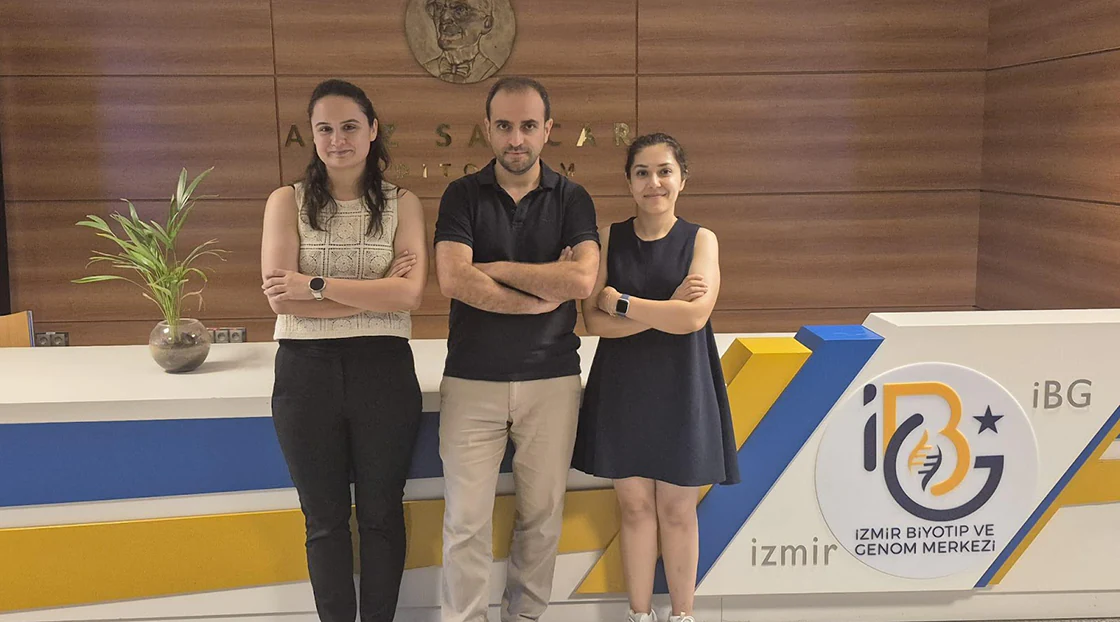
Principal Investigator: Assoc. Prof. Muhammed ÜÇÜNCÜ
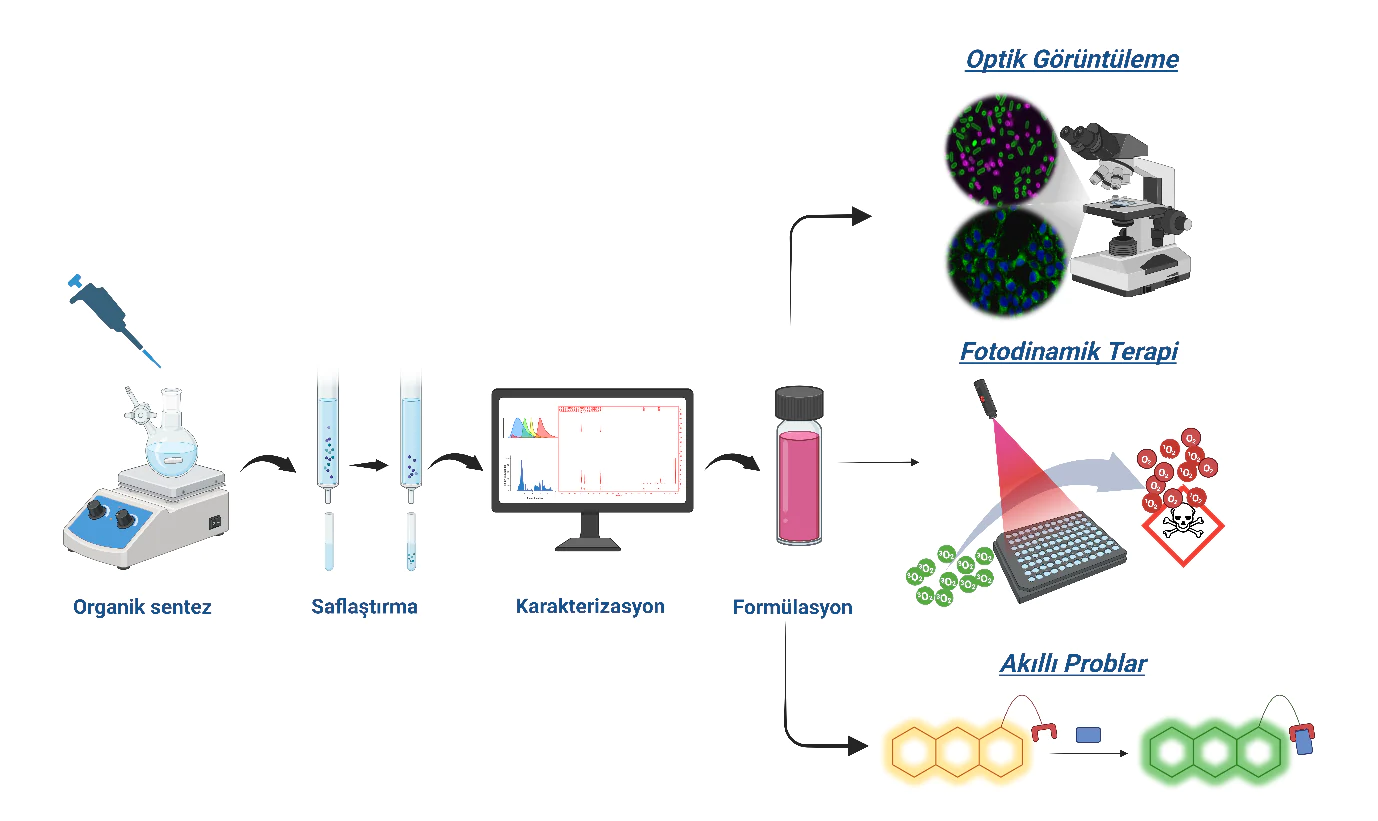
Our research focuses on the functionalization of organic dyes exhibiting fluorescence emission or photosensitizing properties through various chemical modifications, and the application of these structures in theranostic approaches. In this context, we conduct studies aimed at both the optical imaging and photodynamic therapy (PDT)-based treatment of cancer and pathogen-related infections. Additionally, in our laboratory, fluorescent molecules are appropriately modified to develop test kits for the detection of environmental pollutants, whose toxic effects may manifest even at trace levels.
Research Areas
1- Development of Optical Imaging Agents
Research is conducted on the development of fluorescence-based sensors for optical imaging of cancer and pathogen-induced infections. Within this scope, imaging agents with high selectivity and sensitivity are designed using various platforms such as organic small molecules and nanoparticle-based systems.
2- Photodynamic Therapy (PDT) Applications
Next-generation photosensitizers and appropriate carrier platforms are being developed for photodynamic therapy and antimicrobial PDT applications. Studies are conducted to evaluate the therapeutic efficacy of the developed systems both in vitro and in suitable biological models.
3- Design of Smart Molecules for Detection of Environmental Pollutants
Research focuses on the design and synthesis of fluorescence-based smart sensor molecules that enable selective and highly sensitive detection of environmental pollutants. These studies aim for the rapid and reliable analysis of pollutants, even at trace levels, due to their potential toxic effects.
Publications
Saygili, E., Kibris, E., Gelen, S. S., Eldem, A., Odaci, D., &Ucuncu, M. (2025). A novel phenalenone-based probe for dual-mode hydrazine detection. Microchemical Journal, 215, 114263.
Eldem, A., Kibris, E., &Ucuncu, M. (2025). A selective BODIPY-based fluorescent sensor for the detection of Cu²⁺ ions in biological and environmental samples. Spectrochimica Acta Part A: Molecular and Biomolecular Spectroscopy, 125909.
Eldem, A., Tekintaş, Y., Ucuncu, M., &Horzum, N. (2025). Electrospun Nanofiber Platforms for Photodynamic Therapy: Role and Efficacy in Cancer, Antimicrobial, and Wound Healing Applications. Macromolecular Materials and Engineering, 2500014.
Baibek, A., Konieczna, Z., Üçüncü, M., Alghamdi, Z. S., Sharma, R., Horrocks, M. H., & Bradley, M. (2024). A Long Fluorescence Lifetime Probe for Labeling of Gram-Negative Bacteria. Chemical & Biomedical Imaging.
Colvin, L., Al Husseini, D., Tu, D., Dunlap, D., Lalonde, T., Üçüncü, M., ... &Coté, G. L. (2024). Computational Model-Assisted Development of a Nonenzymatic Fluorescent Glucose-Sensing Assay. ACS Sensors, 9(11), 6218–6227.
Poursharifi, N., Hassanpouramiri, M., Zink, A., Ucuncu, M., &Parlak, O. (2024). Transdermal Sensing of Enzyme Biomarker Enabled by Chemo‐Responsive Probe‐Modified Epidermal Microneedle Patch in Human Skin Tissue. Advanced Materials, 36(30), 2403758.
Saygili, E., Ersoz-Gulseven, E., Kıbrıs, E., Cakan-Akdogan, G., &Ucuncu, M. (2024). A novel 2-aminophenalenone-based fluorescent probe designed for monitoring H₂O₂ for in vitro and in vivo bioimaging. Talanta, 271, 125669.
Alghamdi, Z. S., Sharma, R., Kiruthiga, N., Üçüncü, M., Klausen, M., Santra, M., ... & Bradley, M. (2024). Lighting up Mycobacteria with membrane-targeting peptides. Organic & Biomolecular Chemistry, 22(44), 8781–8786.
Saygili, E., Ucuncu, M., &Horzum, N. (2024). Colorimetric detection of hydrogen peroxide using nanozymes. In Nanozymes (pp. 295–314). Elsevier.
Ucuncu, M. (2023). A Phenalenone-based fluorescent probe for the detection of Fe³⁺ ions. Journal of Fluorescence, 33, 707–712.
Eren, M. Ç., Eren, A., Dartar, S., Kaya, B. U., Üçüncü, M., Varlikli, C., ... &Emrullahoğlu, M. (2023). A reaction-based scenario for fluorescence probing of Au(III) ions in human cells and plants. Organic & Biomolecular Chemistry, 21(39), 7880–7885.
Sharma, R., Rajagopalan, H., Klausen, M., Jeyalatha, M. V., Üçüncü, M., Venkateswaran, S., Anand, A. R., & Bradley, M. (2022). Rapid detection of major gram-positive pathogens in ocular specimens using a novel fluorescent vancomycin-based probe. Sensors & Diagnostics, 1, 1014–1020.
Üçüncü, M. (2022). A BODIPY-based probe for the reversible "turn-on" detection of Au(III) ions. Turkish Journal of Chemistry, 46, 523–529.
Zhang, S., Zhang, Y., Üçüncü, M., Lilienkampf, A., Geng, J., & Bradley, M. (2021). Light-controlled, living radical polymerisation mediated by fluorophore-conjugated RAFT agents. Polymer, 226, 123840.
Dartar, S., Üçüncü, M., Karakuş, E., Hou, Y., Zhao, J., &Emrullahoglu, M. (2021). BODIPY–vinyl dibromides as triplet sensitizers for photodynamic therapy and triplet–triplet annihilation upconversion. Chemical Communications, 57, 6039–6042.
Üçüncü, M.,*Zeybek, H., Karakuş, E., Üçüncü, C., &Emrullahoğlu, M.* (2021). A new fluorescent “turn on” probe for rapid detection of biothiols. Supramolecular Chemistry, 32(12), 634–641.
Baibek, A., Ucuncu, M., Short, B., Ramage, G., Lilienkampf, A., & Bradley, M. (2021). Dyeing fungi: Amphotericin B-based fluorescent probes for multiplexed imaging. Chemical Communications, 57, 1899–1902.
Baibek, A., Ucuncu, M., Blackburn, E.A., Bradley, M., &Lilienkampf, A. (2021). Wash-free, peptide-based fluorogenic probes for microbial imaging. Peptide Science, 113(1), e24167.
Zhang, Y., Üçüncü, M.,+ Gambardella, A.,+ Baibek, A., Geng, J., Zhang, S., Clavadetscher, J., Litzen, I., Bradley, M., &Lilienkampf, A. (2021). Bioorthogonal swarming: In situ generation of dendrimers. Journal of the American Chemical Society, 142(52), 21615–21621.
Projects
Principal Investigator
- TÜBİTAK 2247-D: Activatable PDT: Activation of Cage Photosensitizers with Heterogeneous Palladium Catalyst Systems and In Vitro Photodynamic Therapy Applications (Completed)
- TÜBİTAK 3501: Design, synthesis, and imaging applications of phenalenone-based H₂O₂-sensitive chemosensors (Completed)
- IKCU – BAP: In vitro applications of activatable photosensitizers in cancer cells (Completed)
- IKCU – BAP: Design, synthesis, and sensor applications of BODIPY-based chemosensors for metal ion detection (Completed)
- IKCU – BAP: Design, synthesis, and metal cation selectivity study of a novel phenalenone-based chemosensor (Completed)
Researcher
- TÜSEB – Group A Emergency R&D Call: Investigation of antimicrobial photodynamic therapy efficacy of photosensitizer–seragenin combination (Completed)
Advisor
- TÜBİTAK 2218: Selective photodynamic therapy application on a chip-based lung cancer model (Ongoing)
- TÜBİTAK 2218: In vitro imaging of melanoma cells by fluorimetric methods and treatment with activatable photodynamic therapy (Ongoing)
- TÜBİTAK 2218: Computational identification of PROTAC candidates with therapeutic potential targeting Zika virus proteins (Ongoing)
- TÜBİTAK 1001: Synthesis and biological activity evaluation of new thiazolopyrimidine-pyrrolamide derivatives as DNA GyraseB inhibitor antibacterial agents (Ongoing)
- TÜBİTAK 2218: Synthesis and characterization of Protoporphyrin IX-loaded, folic acid and polyethylene glycol-coated ZIF-8, and investigation of its photodynamic therapy activity on breast cancer cells (Completed)
Staff
Active Members
Dr. Öğr. Üyesi Ecem Saygılı
Dr. Aslı Eldem
Contact: muhammed.ucuncu@ibg.edu.tr